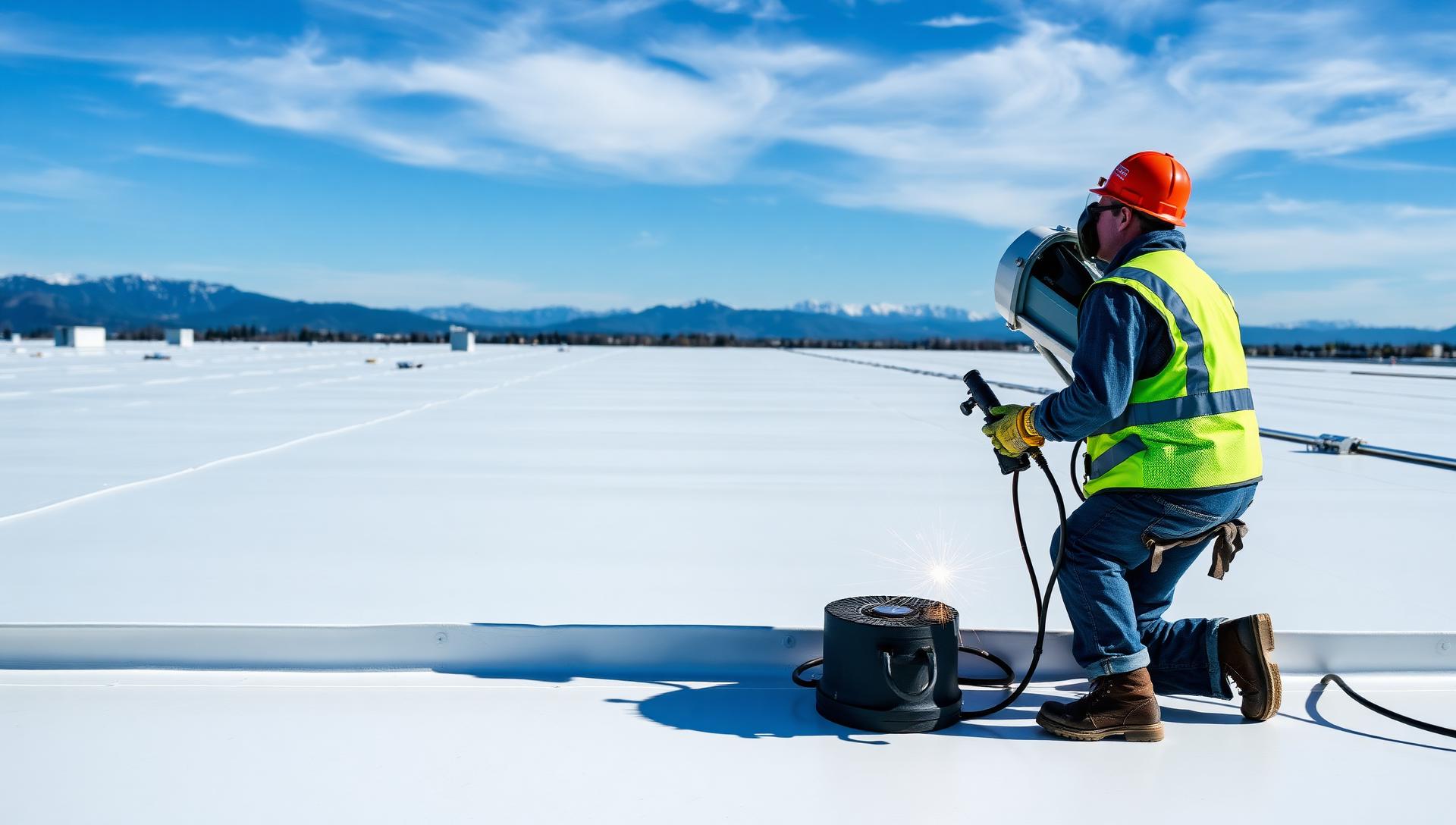
TPO Roofing Guide for BC Commercial & Industrial Buildings
Thermoplastic polyolefin (TPO) is the most specified flat roofing system across British Columbia — energy-efficient, heat-welded, and engineered for our wet Pacific climate. Here's everything property managers, owners and facility teams should know.
Serving Commercial & Industrial Roofing Projects Across British Columbia
TPO Roofing — Quick Overview
The core specs every BC commercial property owner should know before specifying a flat roofing system.
Lifespan
20–30 yrs
Cost Level
Medium
Energy Efficiency
High (Cool Roof)
Maintenance
Low–Medium
Best For
Warehouses, Strata, Retail
Repairability
Excellent
What Is TPO Roofing?
TPO (thermoplastic polyolefin) is a single-ply roofing membrane composed of polypropylene and ethylene-propylene rubber, reinforced with a polyester scrim. It's the dominant material in modern commercial roofing BC projects.
The membrane is rolled out across the prepared deck and insulation, then mechanically fastened, fully adhered, or ballasted. Seams are hot-air welded to form a single continuous waterproofing layer.
TPO is specified across flat roofing systems, low slope roofing, and industrial roofing applications — from warehouses in Surrey to strata buildings in Vancouver and food-processing plants in the Fraser Valley.
BC contractors prefer TPO because its welded seams shrug off the rain that defeats adhesive-based systems, and the reflective white surface helps meet modern energy code targets.
Benefits of TPO Roofing
Why TPO has become the default specification for new commercial and industrial roof membrane systems.
Energy Efficient
Reflective white membrane reduces cooling loads and HVAC costs across BC commercial buildings.
UV & Chemical Resistant
Engineered to resist UV degradation, ozone and most rooftop chemicals common to industrial sites.
Heat-Welded Seams
Hot-air welded seams form a monolithic membrane — far stronger than EPDM adhesive joints.
Lightweight System
Lower structural load than tile or built-up roofing, ideal for retrofits on existing buildings.
Climate Flexible
Stays flexible through BC's freeze-thaw cycles and absorbs thermal movement without cracking.
Long Service Life
With biannual inspections, TPO roofs reliably deliver 20–30 years of waterproof performance.
Get a free site assessment for your commercial roof
Roofer Squad — serving British Columbia commercial & industrial properties.
Common TPO Roofing Problems
The five issues our inspection teams find most often on aging commercial flat roofs across British Columbia.
Seam Failures
- Cause
- Improper welding temperature, dirty surfaces, or aging adhesive transitions.
- Symptoms
- Lifted edges, bubbles along seams, water staining below.
- Repair Solution
- Heat-weld a TPO cover strip over the failed seam after cleaning and probing the full length.
Ponding Water
- Cause
- Insufficient slope, blocked drains, compressed insulation, or settled deck.
- Symptoms
- Standing water 48+ hours after rainfall, dirt rings, accelerated membrane wear.
- Repair Solution
- Install tapered insulation, add overflow scuppers, and clear all primary/secondary drains.
Membrane Punctures
- Cause
- Foot traffic, dropped tools, hail, or HVAC service damage.
- Symptoms
- Visible cuts, isolated leaks under penetrations, damp insulation cores.
- Repair Solution
- Cut a TPO patch with rounded corners, prime, and heat-weld with a 50 mm overlap.
Flashing Failures
- Cause
- Movement at parapet walls, curbs and pipe boots; UV breakdown of sealants.
- Symptoms
- Leaks at perimeters, pipe penetrations, or HVAC curbs after storms.
- Repair Solution
- Re-flash with new TPO membrane, T-joint covers and water cut-off mastic at terminations.
Poor Installation
- Cause
- Inadequate fastening pattern, missed welds, wrong membrane thickness for exposure.
- Symptoms
- Wind uplift, billowing membrane, premature aging across the field.
- Repair Solution
- Independent infrared scan, mechanical re-fastening, and selective re-welding by certified crews.
How TPO Roofing Systems Are Installed
A modern TPO assembly is engineered in layers — each one critical to wind uplift, drainage, and waterproofing performance.
Mechanical Fastening
Plates and screws secure membrane to the deck — fast, cost-effective, and ideal for most BC warehouses.
Fully Adhered Systems
Bonded with low-VOC adhesive for a smooth aesthetic and superior wind uplift on exposed coastal sites.
Ballasted Systems
Loose-laid membrane held by river rock — used on heavy-deck retrofits where penetrations must be minimized.
Insulation Layers
Polyiso (ISO board) and tapered insulation packages engineered to local energy code and slope requirements.
Heat-Welded Seams
Robotic and hand welders fuse seams at 450–620°C, creating a continuous waterproof field membrane.
Edge & Flashing Detail
Coated metal edge, T-joint covers, pipe boots, and termination bars sealed for long-term watertightness.
TPO Roof Repair & Maintenance
Roofer Squad runs structured maintenance programs that keep waterproofing systems performing well past their warranty.
- Routine semi-annual roof inspections
- Electronic and infrared leak detection
- Heat-welded seam repairs by certified technicians
- Drain, scupper and overflow maintenance
- Annual or biannual preventive maintenance contracts
Maintenance saves money
Industry data shows commercial roofs on a structured maintenance program last up to 50% longer than roofs left to fail reactively. Small repairs caught at inspection cost a fraction of emergency leak callouts and interior damage.
Professional Roof Inspections for Flat Roofing Systems
We combine traditional walkover surveys with modern technology to give you a defensible record of roof condition.
Drone Inspections
High-resolution aerial imagery and orthomosaic mapping of the entire roof field.
Infrared Thermal Scanning
Detect wet insulation and concealed moisture invisible to the naked eye.
Moisture Mapping
Capacitance and nuclear surveys to plot saturated zones for targeted repairs.
Core Sampling
Confirm assembly, insulation thickness and substrate condition before tendering.
Maintenance Reports
Photo-documented findings with prioritized repair recommendations and budgets.
Get a free site assessment for your commercial roof
Roofer Squad — serving British Columbia commercial & industrial properties.
Cost of TPO Roofing in British Columbia
No two commercial roofs are identical. Rather than misleading per-square-foot averages, here are the variables that actually drive a TPO project budget in BC.
Every commercial roof is unique and requires a site inspection for accurate pricing. Roofer Squad provides detailed, line-itemed estimates with no obligation.
- Total roof size and geometry
- Tear-off vs. recover requirements
- Insulation thickness and R-value targets
- Site accessibility and crane / hoisting needs
- Building type and occupancy schedule
- Membrane grade (60, 80, or 90 mil)
- Number of penetrations, curbs, and skylights
- Code-required upgrades (drainage, parapet, fire)
TPO vs Other Commercial Roofing Systems
How TPO stacks up against EPDM, PVC and modified bitumen — the other major roof membrane systems used across BC.
TPO vs EPDM
| Cost | Mid | Lower |
| Lifespan | 20–30 yrs | 25–30 yrs |
| Seams | Heat-welded (strongest) | Adhesive / tape |
| Energy Efficiency | High (white) | Low (black) |
| BC Climate Fit | Excellent | Very Good |
TPO vs PVC
| Cost | Mid | Higher |
| Chemical Resistance | Good | Excellent |
| Lifespan | 20–30 yrs | 25–30 yrs |
| Best Use | General commercial | Restaurants, plants |
| Welded Seams | Yes | Yes |
TPO vs Modified Bitumen
| Cost | Mid | Mid |
| Installation | Single-ply welded | Torch / mop applied |
| Energy Efficiency | High | Low–Medium |
| Repairability | Excellent | Good |
| Weight | Light | Heavy |
Frequently Asked Questions
The questions BC property managers ask us most about commercial flat roofing systems.
TPO Roofing Project Gallery
A snapshot of recent commercial and industrial roofing work delivered by Roofer Squad across BC.
Drone Roof Survey
Aerial overview of a 60,000 sq ft TPO recover in Surrey, BC.
Heat-Welded Seam
Close-up of a 50 mm hot-air welded TPO seam under probe testing.
Tapered Insulation
Polyiso crickets directing flow to internal drains on a Burnaby warehouse.
Before / After Repair
Failed flashing rebuilt with new TPO and coated metal edge detail.
Strata Building
Multi-section TPO installation over occupied residential strata in Vancouver.
Industrial Plant
PVC + TPO hybrid system for a chemical processing facility on the Fraser River.
Why Choose Roofer Squad
Built for long-term commercial roofing performance in Canadian weather conditions.
Commercial Specialization
100% commercial & industrial focus — not a residential side business.
Advanced Roof Technology
Drone surveys, infrared scans, and digital condition reports.
Detailed Reporting
Photo-documented inspection reports designed for asset management.
Safety-Certified Crews
WorkSafeBC compliant, fall-protection trained, fully insured.
High Workmanship Standards
Certified TPO, PVC and EPDM installers backed by manufacturer warranties.
BC Climate Experience
Decades of project history in Pacific coastal and interior climates.
Request a Free TPO Roofing Estimate
Tell us about your building. A Roofer Squad estimator will reach out within one business day to schedule a no-obligation site assessment anywhere in British Columbia.
- Free site visit & measurements
- Detailed line-item written estimate
- Photo-documented condition report
- No high-pressure sales tactics
Need Expert Help With Your Commercial Roof?
Protect your building before small leaks become expensive damage. Roofer Squad responds to estimate and inspection requests within one business day.